

Why it matters
If you build with AI agents, OpenAI wrote up how one startup keeps 10,000 of them busy for days. Some of the method carries over to a small setup, and every number in it is the company's own.
What OpenAI's story says
What OpenAI's story says
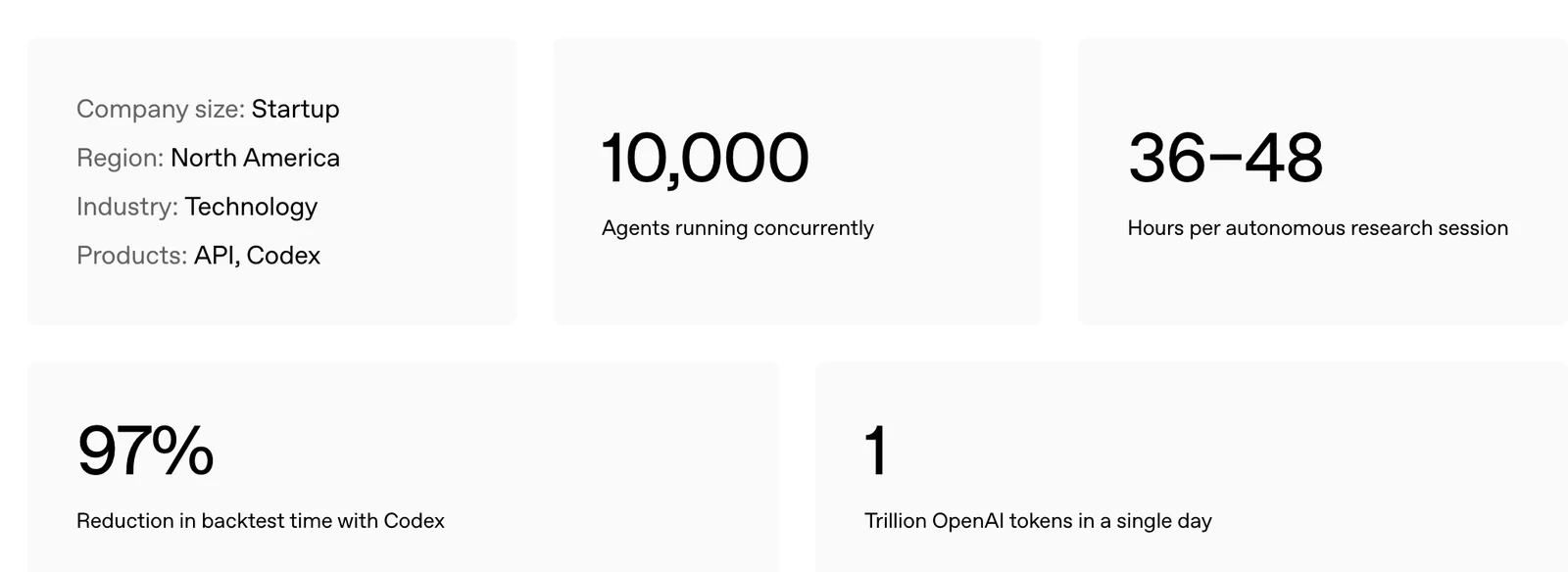
OpenAI published How Third Moment Research runs 10,000 agents for 36+ hours on 14 October 2026, tagged Startup. OpenAI's facts box lists the company as a startup in North America, in technology, using the API and Codex. Third Moment's own site puts it in San Francisco, California. OpenAI's one-line summary says the lab builds agents that focus for days and improve with use.
The stat cards carry four numbers: 10,000 agents running concurrently, 36 to 48 hours per autonomous research session, 97 percent less backtest time with Codex, and 1 trillion OpenAI tokens in a single day. The story does not say which day that was, or whether it was a normal day or a peak. We did not turn the tokens into a price, because the story gives none.
What the company builds, in the story's words, is a self-improving system. It studies how its agents behave, finds recurring weaknesses, creates thousands of synthetic scenarios around them and uses those to improve the agents. One of its early applications is quantitative finance, because success is easy to measure there. The agents work on improving a baseline trading system built by Third Moment's engineers. The story says their work has improved it, and gives no figure.
Adam Khakhar, a co-founder, tells the history. Before GPT-5.5, he says, models could only run experiments a user prescribed. With GPT-5.5 and GPT-5.6, models working with the Codex harness could use results to design follow-up experiments. With GPT-6 Astra, GPT-6 Sol and GPT-6.1 Sol, agents can investigate root causes through hundreds of experiments running in parallel with subagents. That is his account, as OpenAI reports it.
What comes next is a plan, not a result. Third Moment plans to expand from single investigations to hundreds of thousands of collaborating subagents, with a roadmap of trillions of tokens supporting chains of dozens of dependent experiments.
Sources: OpenAI: How Third Moment Research runs 10,000 agents for 36+ hours (14 October 2026) and Third Moment Research, home page (read 30 October 2026)
How it works
How it works, as the story tells it
The setup, per the story: the default Codex harness inside a Dockerized environment. Each agent gets a terabyte of data, documentation and a research repository, and works on feature engineering, GPU model training, trading strategies and simulation.
The first bottleneck was waiting. A backtest of a trading strategy across a year of order-level US equity data took several hours. While waiting, agents repeatedly polled for completion, wasting tokens and filling their context with status checks. Codex profiled the backtest, found a caching optimization and a memory-packing technique, and deployed the fix to production. The story says that took the backtest from approximately 3 hours to approximately 3 to 5 minutes.
The second is a supervisor. Third Moment treats Codex as a subagent inside an outer harness powered by GPT-6 Sol or GPT-6.1 Sol. When a task is left unfinished, the outer harness examines the trajectory and decides whether to retry, terminate the job or escalate to human review.
The third is a security test. Before simulations launch, the team uses Daybreak to automate a check of whether an agent could break out of its research environment and reach the wider network. For targeted work, such as checks for specific security weaknesses, the team uses a more efficient model, GPT-5.6 Terra.
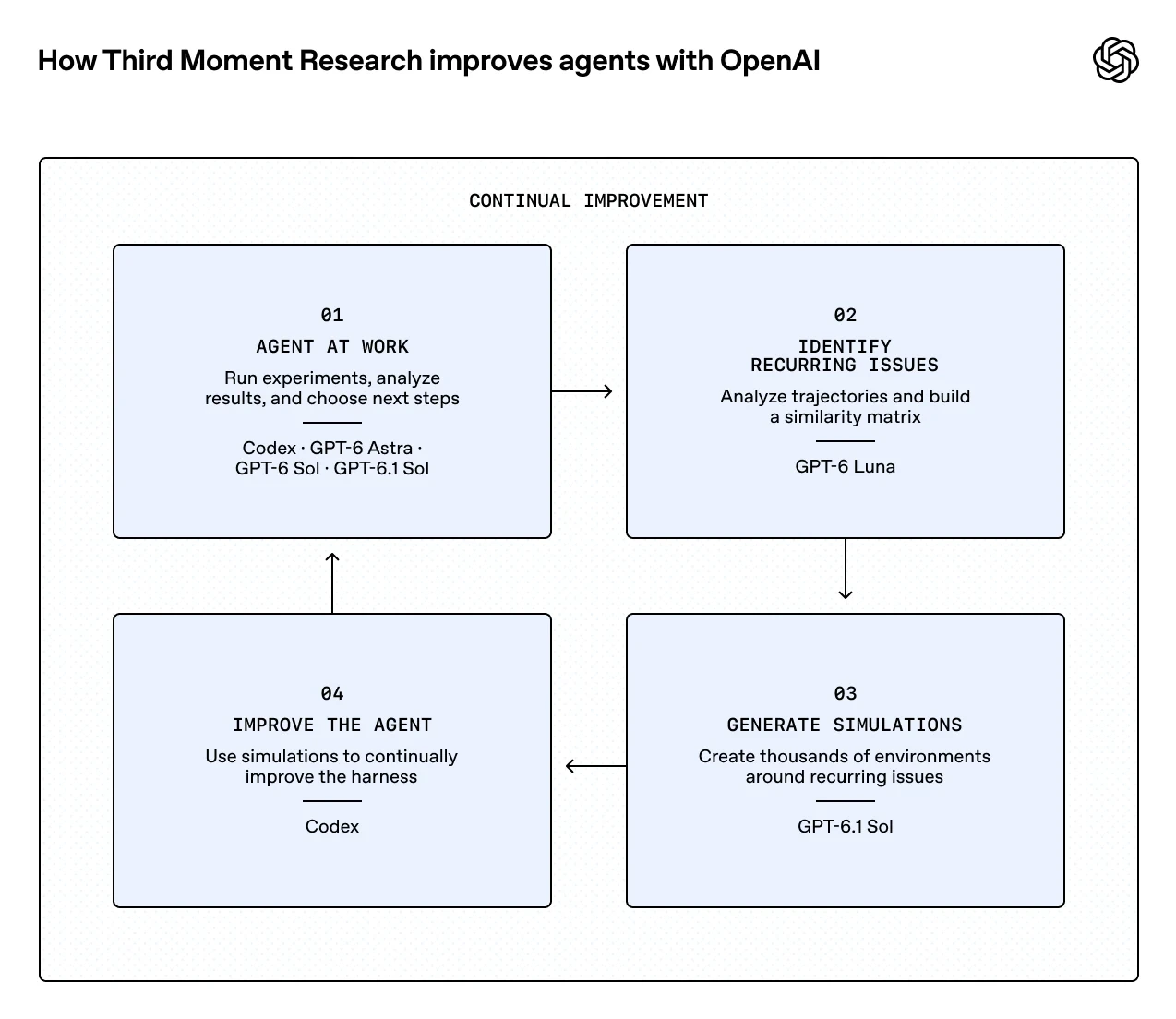
| Step in the loop | What happens | Models and tools the story names |
|---|---|---|
| Agent at work | Runs experiments, analyzes results, and chooses next steps | Codex, GPT-6 Astra, GPT-6 Sol, GPT-6.1 Sol |
| Identify recurring issues | Analyzes trajectories and builds a similarity matrix | GPT-6 Luna |
| Generate simulations | Creates thousands of environments around recurring issues | GPT-6.1 Sol |
| Improve the agent | Uses simulations to continually improve the harness | Codex |
From the loop diagram in OpenAI's story, read 30 October 2026. Codex is OpenAI's coding agent, used here as the harness. The GPT models are the models.
Source: OpenAI: How Third Moment Research runs 10,000 agents for 36+ hours (14 October 2026)
What the numbers are worth
What the numbers are worth
Every number on this page is Third Moment's, as told to OpenAI and published by OpenAI in its own customer story. OpenAI sells the models and the tokens the story is about. We searched on 30 October 2026 and found no outside source for any of the numbers, only reposts of the OpenAI story. The story and an archive copy of 21 October match line for line, so nothing changed in between. Treat the numbers as the company's claims.
Two details the headline leaves out. The Codex speed-up ran on GPT-5.6, which the story calls the latest GPT model at the time, not on a GPT-6 model. And 97 percent is the careful end of the arithmetic: 3 hours to 5 minutes is a 97.2 percent cut, and 3 hours to 3 minutes is 98.3 percent. That arithmetic is ours, on OpenAI's numbers.
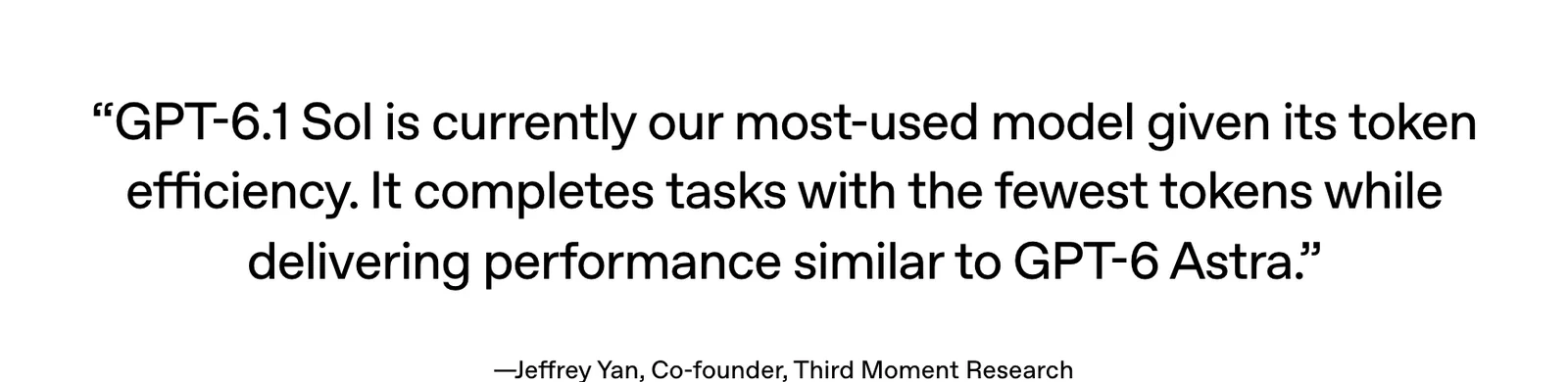
On models, Jeffrey Yan, a co-founder, says GPT-6.1 Sol is currently their most-used model because of its token efficiency: it completes tasks with the fewest tokens while performing similarly to GPT-6 Astra. The story also says that on their own latency benchmark, GPT-6 Astra gave the biggest speedup, according to Adam Khakhar. So most used and fastest are not the same model here.
Daybreak is OpenAI's own cybersecurity programme, set out in OpenAI's post of 22 June 2026, so a security test run with it is also a use of an OpenAI product. The story calls Third Moment this AI lab and tells a trading story. Third Moment's own home page leads with something else: an OpenAI API-compatible endpoint, tuned to your workflow, improved on your real traffic. Both can be true, because the story says trading is one of its early applications.
Sources: OpenAI: How Third Moment Research runs 10,000 agents for 36+ hours (14 October 2026), OpenAI: Daybreak, securing the world (22 June 2026), and Third Moment Research, home page (read 30 October 2026)
Read the sources
Read the sources
Every claim above comes from these pages, read on 30 October 2026. The story has not changed since 21 October.
- Read the storyOpenAI's customer story
The story of 14 October: the stat cards, the loop, the backtest and the quotes.
- Read the postOpenAI on Daybreak
OpenAI's post of 22 June 2026 on its cybersecurity programme.
- Open the siteThird Moment Research
Their own home page: what they sell today, and where they are based.
Yes, that's my AI avatar in the video. Same opinions, better lighting.